
NetSuite SuiteSuccess Implementation for Mid-Market Leaders

Rapid ERP deployment for mid-market leaders relies on NetSuite SuiteSuccess, a phased methodology built from 25-plus years of implementation experience across thousands of organizations. RXD Systems, a NetSuite Alliance Partner, brings mid-market companies live efficiently. The firm combines SuiteSuccess configurations, certified consultants, and transparent project pricing with no hidden costs or retainers.
Key Takeaways
- NetSuite SuiteSuccess methodology draws from 25 years of experience across tens of thousands of organizations globally.
- Mid-market implementations complete in 12-16 weeks through systematic configuration, data migration, integration building, and user training phases.
- Over 70 percent of recently implemented ERP initiatives fail to fully meet objectives without proper methodology and guidance.
- RXD Systems Inc. leverages industry-specific SuiteSuccess editions powered by AI to accelerate business transformation and growth.
What Will NetSuite SuiteSuccess Implementation Accomplish?
A successful NetSuite SuiteSuccess implementation delivers a working ERP system built on proven methodology rather than guesswork. NetSuite SuiteSuccess draws on over 25 years of experience helping tens of thousands of organizations across every industry transform their operations. For mid-market leaders juggling finance, inventory, and operations across multiple business lines, that track record matters more than a generic software rollout.
Mid-market companies gain a critical advantage: their NetSuite account gets configured directly through the SuiteSuccess methodology instead of built from a blank slate. This distinction changes the entire project timeline. Teams spend less time debating architecture and more time validating workflows that already reflect industry standards.
What components come with a SuiteSuccess configuration?
SuiteSuccess delivers predefined components matched to a company’s specific industry and the roles its users actually perform. These aren’t generic templates; they reflect leading practices refined across many implementations. A distribution-focused mid-market leader and a manufacturing-focused one receive different starting points, tuned to their operational reality.
How does this reduce implementation risk for mid-market leaders?
Pre-built industry components mean fewer open decisions during build phases. Mid-market leaders avoid the trap of reinventing processes that NetSuite has already refined through years of client deployments.
Typical outcomes mid-market leaders can expect include:
- Faster alignment between finance, operations, and inventory teams through role-based configurations
- Reduced customization risk since components reflect tested, industry-specific practices
- A clearer path from go-live to daily operational use, rather than months of trial and error
RXD Systems configures these SuiteSuccess foundations for mid-market clients nationwide, adapting predefined components to each company’s actual workflows before go-live.
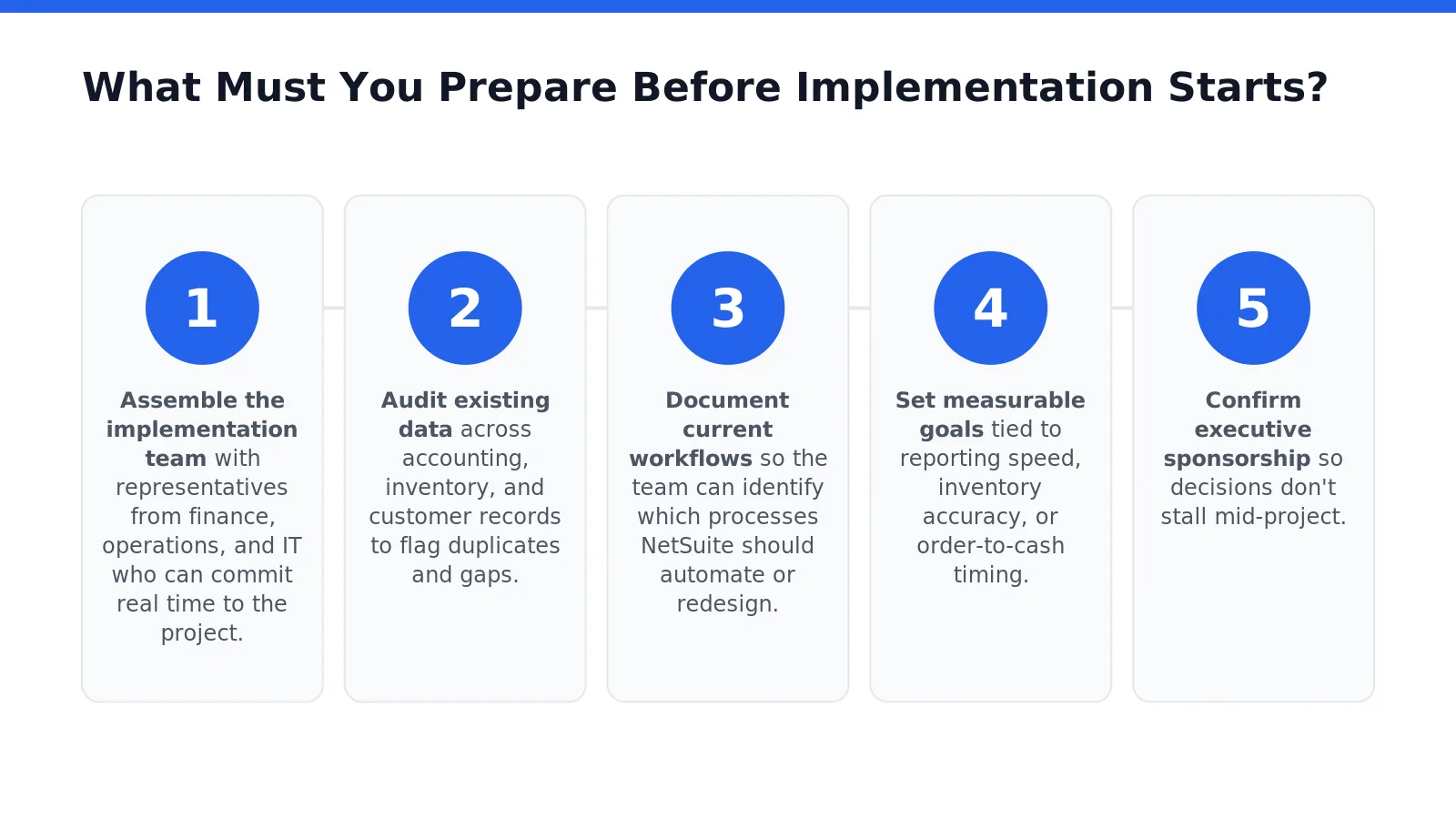
What Must You Prepare Before Implementation Starts?
Careful planning determines whether a mid-market organization’s ERP rollout accelerates growth or stalls it. Strong alignment across the implementation team matters just as much as the technology itself. Mid-market leaders who skip this groundwork often discover gaps only after go-live, when fixing them costs far more time and money.
How Long Does a NetSuite Rollout Take for a Mid-Market Company?
Mid-market leaders should budget for a structured transformation spanning roughly two to twelve months. Timeline depends on company size, the number of modules deployed, integration complexity, and how ready existing data is for migration. Organizations with cleaner financial records and simpler system landscapes move toward the shorter end of that range.
What Steps Should Mid-Market Leaders Take Before Kickoff?
Preparation follows a logical sequence. Mid-market teams should complete each step before moving to the next:
- Assemble the implementation team with representatives from finance, operations, and IT who can commit real time to the project.
- Audit existing data across accounting, inventory, and customer records to flag duplicates and gaps.
- Document current workflows so the team can identify which processes NetSuite should automate or redesign.
- Set measurable goals tied to reporting speed, inventory accuracy, or order-to-cash timing.
- Confirm executive sponsorship so decisions don’t stall mid-project.
Mid-market organizations rarely have deep in-house ERP expertise, which raises the stakes of each preparation step. A netsuite suitesuccess implementation built on solid groundwork reaches value faster and avoids costly rework.
Evaluating the right partner belongs in this preparation phase, not after launch. A Los Angeles, CA-based NetSuite Alliance Partner serves mid-market clients wherever they operate, bringing certified consultants and proven project discipline to each engagement. Choosing a partner early gives the implementation team guidance through every planning decision before the clock starts.
How Do You Scope Your NetSuite Project?
Scope defines the boundaries of a NetSuite project before a single screen gets configured. For mid-market leaders, scoping answers four questions: how the platform gets configured, how existing data moves over, which integrations connect to finance and operations, and how staff get trained before go-live. Skipping this step invites rework later, when fixing a missed integration costs far more than planning for it upfront.
Mid-market organizations should expect a longer runway than smaller companies. According to the NetSuite Implementation Guide 2026, implementations run 12 to 16 weeks for mid-market businesses, compared to 8 to 12 weeks for small companies and 4 to 6 months for enterprise deployments, spanning six distinct phases. Budgets should reflect that reality from the start. The same guide places mid-market implementation fees between pricing varies and pricing varies on top of licensing costs. RXD Systems builds scope documents around this timeline for companies evaluating NetSuite, wherever those leaders operate, ensuring budget and schedule match the complexity ahead.
What Should a Scoping Document Include?
A scoping document should list every module, workflow, and user role the deployment touches. It should also name the data sets slated for migration and the systems requiring integration.
Why Does Scope Determine Project Success?
Treating a NetSuite rollout as a strategic business transformation, rather than a simple software swap, changes how leaders prioritize scope decisions. The Complete Guide to NetSuite ERP Implementation frames the work this way. That framing matters because scope choices ripple into every later phase.
Mid-market leaders scoping a NetSuite SuiteSuccess implementation should confirm the following before kickoff:
- Document current workflows across finance, inventory, and operations.
- Identify which integrations (ecommerce, EDI, shipping platforms) are mission-critical versus optional.
- Define data migration priorities, separating historical records from active transactional data.
- Assign training ownership for each department touched by the new system.
Clear scope up front protects both timeline and budget through go-live.
How Does SuiteSuccess Build Your Foundation?
SuiteSuccess builds a mid-market company’s foundation through a phased methodology that matches NetSuite configuration to the realities of that business. Industry-specific editions let a growing distributor, wholesaler, or manufacturer adopt the platform in stages rather than all at once. This phased path reduces the risk of a stalled rollout and gives mid-market leaders room to expand usage as operations scale.
Rushing an ERP rollout without this structure often means paying twice: once for the implementation, and again to fix gaps later. SuiteSuccess exists precisely to close that gap before it opens.
What Happens During the Build Phase?
The Build phase assembles the working core of a mid-market company’s NetSuite environment. NetSuite SuiteSuccess implementation delivers AI-powered, industry-specific processes paired with KPIs, role-based dashboards, and standard reports tailored to the business. Workflows get configured around how the company actually operates, not a generic template. Flexibility remains built in, so finance, operations, and supply chain teams can customize further as needs shift.
Does SuiteSuccess Offer Industry-Specific Configurations?
Yes. SuiteSuccess editions exist for specific industries, giving mid-market leaders a starting configuration built for their sector rather than a one-size-fits-all setup.
Consider how this plays out across common mid-market profiles:
- A distributor gets dashboards weighted toward inventory turns and fulfillment accuracy.
- A manufacturer receives KPIs centered on production costs and landed cost visibility.
- A wholesaler sees reporting structured around order volume and supplier performance.
Choosing the right edition matters. Mid-market leaders who select an industry-matched configuration avoid months of manual customization. RXD Systems guides that selection process, applying certified NetSuite expertise to confirm each client’s edition fits its actual operating model before go-live begins.
How Do You Configure And Test NetSuite?
Configuration starts with a single truth: NetSuite operates as one cloud-based enterprise resource planning (ERP) platform built to manage core operations from a unified system. Mid-market leaders evaluating a deployment need a structured path from blank system to live environment, not a patchwork of guesses. RXD Systems configures and tests NetSuite for mid-market leaders nationwide, delivering remote and on-site support regardless of where headquarters sit.
The configuration phase follows a defined sequence:
- Map core financial, operational, and customer workflows before touching the system.
- Build the chart of accounts, dashboards, and role-based forms around those workflows.
- Connect financials, operations, customer records, and reporting into one centralized platform so leadership gains cross-departmental visibility.
- Configure industry-specific components tied to NetSuite SuiteSuccess implementation, including predefined KPI scorecards and center tabs.
- Run department-level sign-off before advancing to testing.
What Should Testing Confirm Before Go-Live?
Testing confirms the value-driven dashboard model actually improves efficiency and effectiveness for end users, not just that screens load correctly. RXD Systems validates this by walking finance, operations, and customer-facing teams through real transaction scenarios inside each mid-market leader’s configured environment. Any gap between intended workflow and user experience gets flagged and corrected before cutover.
How Long Does Testing Usually Take?
Timelines vary by complexity and the number of integrated systems a mid-market leader operates. Testing should never be rushed simply to meet a launch date; skipped validation cycles create downstream errors in reporting and reconciliation.
Mid-market leaders that treat configuration and testing as sequential, documented phases avoid the scramble of post-launch fixes. RXD Systems structures both phases around measurable checkpoints, giving decision makers confidence before data ever touches a live transaction.
How Do You Deploy And Go Live?
Deployment follows a structured path from configuration through cutover, built on proven project management discipline. Mid-market leaders face a specific risk at this stage: rushed go-lives that skip validation steps often create downstream accounting errors and stalled adoption. RXD Systems structures deployment so those losses never materialize, guiding mid-market organizations through each phase before granting sign-off.
A go-live checklist for mid-market leaders typically includes these steps:
- Confirm data migration accuracy against source systems before any cutover date is set.
- Validate configured workflows against documented business requirements for finance, operations, and supply chain.
- Run user acceptance testing with role-based scenarios across every department using the system.
- Complete end-user training so staff understand new processes on day one.
- Execute cutover during a defined low-activity window to limit operational disruption.
- Monitor performance closely during the first weeks post-launch and resolve issues through a tracked support process.
How Long Does A Mid-Market NetSuite Go-Live Take?
Mid-market companies should plan for roughly twelve to sixteen weeks from kickoff to go-live, a notably tighter window than the four to six months larger enterprises typically require. That timeline reflects a scoped, phased rollout rather than an all-at-once deployment across every business unit.
Why Does Suitesuccess Methodology Matter At Go-Live?
A phased NetSuite SuiteSuccess implementation structures go-live around incremental adoption instead of a single disruptive cutover. Mid-market leaders following this methodology see faster time-to-value, stronger employee adoption, and quicker ROI once the system is live. NetSuite’s 2026 platform updates have also deepened native AI capabilities, giving mid-market finance and operations teams intelligent automation baked into go-live planning from day one. RXD Systems applies this methodology directly to each mid-market engagement it manages.
What Support Comes After Go-Live?
Support after go-live centers on turning a new system into a lasting business transformation, not closing a project folder. For mid-market leaders, the real payoff arrives once NetSuite centralizes core business functions and gives finance, operations, and warehouse teams a real-time view of performance. That visibility drives faster, data-driven decisions across every department, from inventory planning to cash flow forecasting.
A NetSuite implementation rarely ends at launch. Treating it as a one-time software installation leads mid-market leaders to underinvest in the months that follow, when adoption gaps and configuration gaps typically surface. Sustained success depends on viewing the deployment as an ongoing transformation, one that keeps evolving as reporting needs, headcount, and integrations change.
How much does ongoing NetSuite support cost after launch?
Costs continue beyond the initial implementation fees. Mid-market organizations should budget for a recurring base license plus per-user subscription costs that run monthly, in addition to any support or optimization hours. Planning for these figures early prevents budget surprises down the road.
Post-go-live support for mid-market leaders typically includes:
- Issue triage and resolution through a structured ticketing or portal process
- Periodic health checks to confirm configurations still match current workflows
- Guidance on adding modules or users as the business scales
- Reporting refinements tied to evolving KPIs
What happens if post-go-live support gets skipped?
Skipping structured support stalls the transformation before it delivers full value. Dashboards go unused, workflows drift from original design, and the real-time visibility promised at launch quietly erodes. Consistent post-launch attention keeps the platform aligned with how the business actually operates.
What Mistakes Derail Mid-Market Deployments?
Weak planning derails more mid-market NetSuite rollouts than any technical glitch. Gartner projects that by 2027, more than 70 percent of recently implemented ERP initiatives will fail to fully meet their original business case, a warning mid-market leaders cannot afford to ignore. Skipping structure costs mid-market organizations dearly: deployments without a disciplined approach commonly suffer delays, cost overruns, and low user adoption across finance, operations, and warehouse teams alike.
Mid-market leaders evaluating an ERP overhaul tend to repeat a predictable set of errors. The most common include:
- Treating the project as an IT task instead of a company-wide business transformation.
- Underestimating data migration complexity across inventory, order management, and legacy accounting systems.
- Delaying user training until after go-live, leaving staff unprepared for new workflows.
- Skipping a phased rollout plan, forcing every department live at once with no buffer for correction.
Each mistake compounds the next. A rushed timeline produces untested integrations; untested integrations produce support tickets that pile up for months.
Why Do Some NetSuite Projects Succeed While Others Stall?
Disciplined planning and close partner alignment separate successful deployments from stalled ones. Centium‘s own NetSuite implementation success rate stands at 98 percent, a figure that reflects what structured governance, realistic timelines, and experienced oversight deliver for mid-market leaders. A NetSuite SuiteSuccess implementation, guided by certified consultants, builds that structure in from day one rather than retrofitting it after problems surface.
Mid-market leaders gain the most protection by pairing phased adoption with continuous post-go-live support. That combination keeps adoption rates high, budgets predictable, and operational disruption to a minimum.
FAQ
How long does a NetSuite SuiteSuccess implementation take for mid-market companies?
Mid-market implementations complete in 12-16 weeks through systematic configuration, data migration, integration building, and user training phases, using the SuiteSuccess methodology.
What makes RXD Systems qualified to lead a SuiteSuccess implementation?
RXD Systems Inc., based in Los Angeles, CA, operates as a NetSuite Alliance Partner, using certified consultants, SuiteSuccess configurations, and transparent project pricing with no hidden costs or retainers.
Why do SuiteSuccess configurations reduce risk compared to a standard ERP build?
Predefined, industry-specific components reduce open decisions during build phases, letting mid-market leaders avoid reinventing processes NetSuite has already refined across thousands of organizations.
Conclusion
In closing, SuiteSuccess delivers the rapid, disciplined approach mid-market leaders need to stabilize operations and unlock NetSuite’s full potential. By combining proven implementation methodology with certified expertise and pragmatic consulting, organizations accelerate time-to-value while building a scalable foundation for growth. The path forward demands clarity, accountability, and a partner committed to your success, not just project completion.