
NetSuite Project Rescue: Revive Your Stalled ERP

Stalled NetSuite implementations usually require a configuration freeze first, halting further changes so a certified team can assess root causes like scope creep, dirty data, or weak sponsorship. RXD Systems provides NetSuite consulting, implementation, optimization, and support services as a NetSuite consultant in Los Angeles, diagnosing these gaps and building a remediation plan. Most failed projects are recoverable without a costly full restart.
Key Takeaways
- Most failed NetSuite projects recover successfully through structured rescue rather than complete system restarts.
- Implementation freezes stop configuration changes, stabilize troubled projects, and enable accurate root cause assessment.
- Scope creep and data quality issues drive NetSuite failures more than visible symptoms suggest.
- RXD Systems identifies stalled implementations through budget overruns, unmet requirements, and ineffective operational support.
What Should You Prepare Before a NetSuite Rescue?
Preparation determines whether a recovery effort gains traction in weeks or drags on for months. Organizations with a stalled or underperforming system need to stabilize current operations before expanding into new business lines. That stabilization work starts with an honest internal inventory. CFOs and IT directors should treat the weeks before engagement as diagnostic time, not downtime.
What documents should a company gather first?
Leadership should assemble implementation scope documents, current configuration notes, and a list of known workflow failures. Financial teams benefit from pulling recent reconciliation reports, since accounting gaps often surface root causes faster than technical logs. Having this material ready lets a NetSuite project rescue team move directly into assessment instead of spending early sessions requesting basics.
Who needs to be in the room?
Recovery stalls when decision-makers stay absent. Finance leaders should expect direct involvement from CPAs and finance consultants, who join rescue engagements specifically to strengthen accounting accuracy and compliance posture during the turnaround. IT directors should plan for close coordination with technical staff who understand the existing build.
Before formal kickoff, organizations should:
- Document every known failure point, from reporting errors to broken integrations
- Identify internal stakeholders authorized to approve configuration changes
- Clarify whether the goal is pure stabilization or stabilization plus expansion to new entities or geographies
- Confirm internal budget flexibility, since engagements run without minimum hours, monthly retainers, or hidden costs
This structure gives finance leaders room to scale support up or down as root causes emerge, rather than locking into a fixed-scope contract before the real damage is understood.
How Do You Confirm Your NetSuite Project Needs Rescue?
A stalled timeline, a budget that keeps climbing, or a system that fails to meet core business requirements all signal that a project has entered rescue territory. Mid-market leaders often sense something is wrong long before they name it. Unfinished workflows, reporting gaps, and reluctant end users are the clearest warning signs, and waiting to address them only deepens the disruption to finance, operations, and supply chain functions.
What Are the Signs a NetSuite Implementation Is Failing?
Several patterns repeat across troubled implementations. Each one, on its own, may seem manageable, but together they point to a project in distress:
- Go-live dates pushed back repeatedly without a clear remediation plan
- Budget overruns that outpace the original scope of work
- A system that does not support day-to-day operations effectively
- Low adoption rates among finance, warehouse, or sales teams
- Reporting that does not match what leadership needs to make decisions
Recognizing these signs early gives a company more options and lower costs for correction.
Who Can Assess Whether a NetSuite Project Is Salvageable?
Determining whether a project can be saved requires a partner with deep implementation history. An experienced NetSuite consulting partner recognizes patterns that separate fixable configuration issues from fundamental redesign problems. That kind of track record matters, because every failed project looks different on the surface even when the root causes repeat.
A trusted NetSuite consultant providing implementation, optimization, and support services is a reasonable party to perform this evaluation. Retailers, wholesalers, distributors, and manufacturers facing complex integrations or process redesign are the organizations most likely to confront this decision point. Their operational dependencies on NetSuite leave little room for prolonged instability.
How Do You Freeze Configuration Before Assessment?
Once leadership suspects trouble, a configuration freeze should be implemented immediately to halt further system changes and establish a stable baseline, setting the stage for a thorough assessment of why the project is in trouble. Stalled workflows, broken reports, and low user adoption only compound when consultants and internal teams keep editing the same environment mid-crisis. The freeze is not a punishment; it is a diagnostic necessity.
Why does stopping changes come first?
Additional edits during a crisis obscure the real cause of failure. Stopping further modification prevents new damage and creates the stable baseline needed for an accurate assessment. Without that pause, every fix attempt risks layering a new problem on top of an old one, making root-cause analysis nearly impossible.
What does a freeze actually involve?
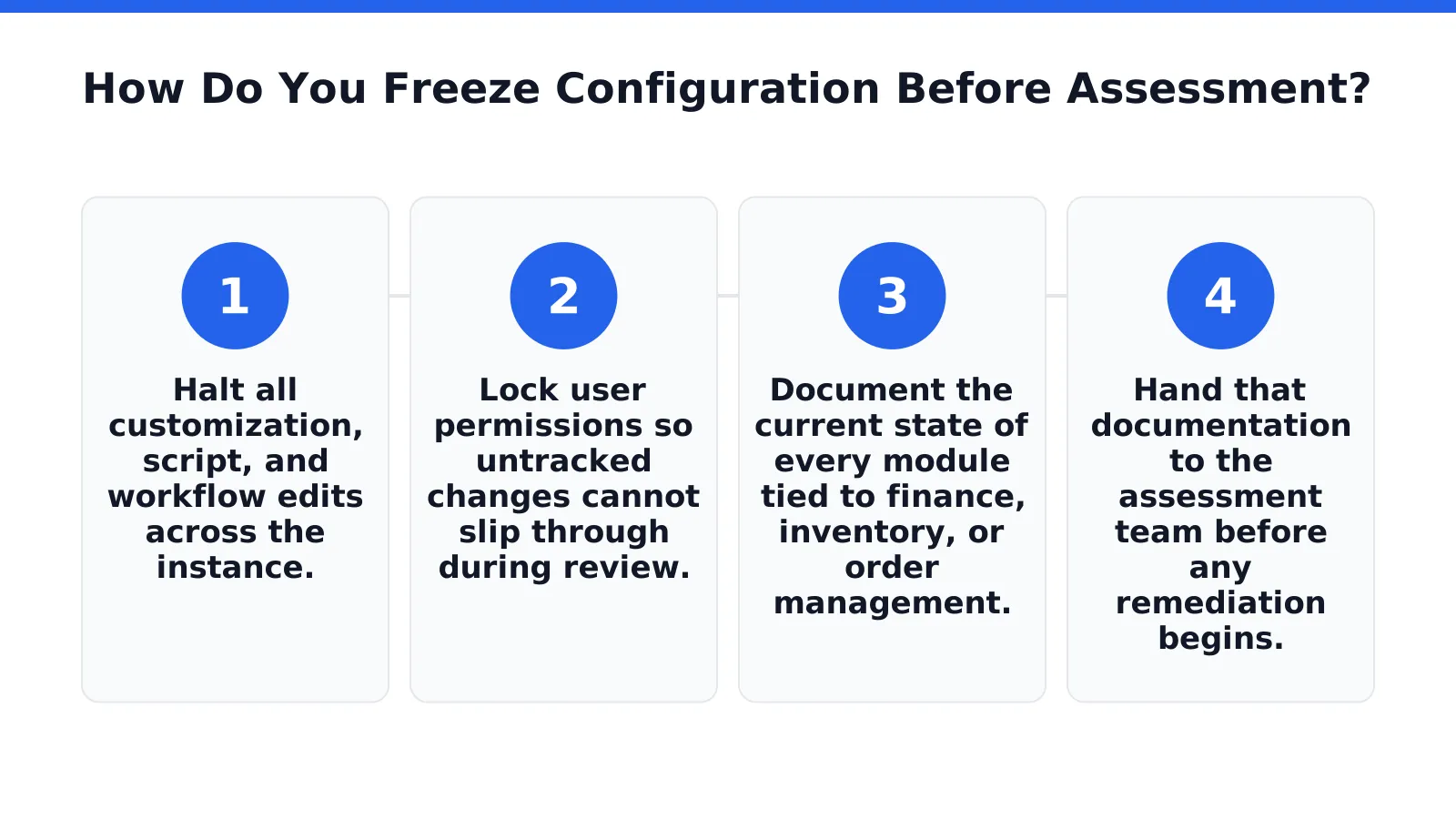
A disciplined freeze follows a clear sequence:
- Halt all customization, script, and workflow edits across the instance.
- Lock user permissions so untracked changes cannot slip through during review.
- Document the current state of every module tied to finance, inventory, or order management.
- Hand that documentation to the assessment team before any remediation begins.
Executing that sequence requires more than a memo telling staff to stop. It demands project management discipline and a direct, candid consulting style that keeps stakeholders aligned on what “frozen” actually means day to day. RXD Systems brings that discipline to troubled engagements, treating the freeze as the first checkpoint in a structured NetSuite project rescue, not an afterthought.
Visibility matters just as much as restraint. Clients track every open issue through a dedicated issue management portal, so finance leaders. IT directors see exactly what is paused, what is pending, and what the assessment team has flagged. That transparency keeps the freeze from feeling like a blackout. Leadership gets a running record of system status while the deeper diagnostic work proceeds behind the scenes.
How Do You Diagnose Root Causes Of Failure?
Diagnosis starts by separating symptoms from causes. A missed go-live date or a flood of user complaints signals trouble. The underlying root causes matter more than the visible symptoms a business notices first. Finding them requires a structured look at scope, data, leadership, and training rather than a quick patch to whatever broke most recently.
Four factors drive most failed deployments: scope creep that expands requirements mid-project, dirty data carried over from legacy systems, weak executive sponsorship, and insufficient end-user training. These issues rarely announce themselves directly. They surface instead as slow processes, inaccurate reports, or employees reverting to spreadsheets.
What Should A Root Cause Assessment Actually Examine?
A thorough assessment reviews configuration decisions, data migration quality, workflow design, and the level of leadership engagement throughout the project. Consultants trace each operational breakdown back to its origin rather than treating it in isolation.
- Configuration settings that no longer match current business requirements
- Data fields imported incorrectly or left incomplete during migration
- Approval and process workflows built without input from actual users
- Sponsorship gaps where decisions stalled without a clear executive owner
Industry context sharpens this diagnostic work considerably. Experience across manufacturing, wholesale distribution, retail, eCommerce, and supply chain operations helps consultants recognize why a specific configuration broke down for a specific business model, rather than applying generic fixes.
How Do Consultants Turn Diagnosis Into Action?
Diagnosis only has value when it leads to correction. Consultants guide a NetSuite project rescue through strategic planning, system optimization, integration fixes, and reporting improvements, pairing each identified root cause with a concrete remediation step before moving forward.
How Do You Build A Recovery Plan And Team?
Building a recovery plan starts with an honest assessment of the current NetSuite configuration. A structured NetSuite project rescue identifies root causes, stabilizes high-risk workflows, and realigns the system to match how the business actually operates. Skip that diagnostic step, and the next phase of work simply builds on the same cracked foundation.
A workable plan moves through a defined sequence rather than a scattershot list of fixes. The order matters because each step depends on the findings from the one before it.
- Assess the live configuration and catalog every customization, workflow, and integration currently in use.
- Pinpoint the root causes behind missed deadlines, broken reports, or poor user adoption, not just the visible symptoms.
- Stabilize the highest-risk areas first, such as financial close, order management, or inventory accuracy.
- Realign the realigned system to how the business operates day to day, not how it was originally scoped.
- Name an executive sponsor with authority to approve scope and budget decisions on the spot.
- Scale consultant involvement up or down as the plan progresses, rather than locking into a fixed retainer.
Who Should Lead The Recovery Effort?
Recovery stalls quickly without a sponsor who holds the authority to make binding decisions throughout the plan. That person signs off on scope changes, resource shifts, and timeline adjustments without waiting on a committee. A pragmatic, candid consulting style keeps that sponsor engaged and accountable at every phase of the rebuild, instead of disappearing once the kickoff meeting ends.
How Is Recovery Support Structured And Billed?
Delivery runs on a project-led, outcomes-focused model, supported by certified consultants across technical and functional domains. No minimum-hours requirement and no standing retainer mean support expands or contracts as the recovery plan evolves. That flexibility matters most in the early weeks, when the true scope of the problem is still coming into focus.
How Do You Stabilize Data And Rebuild Workflows?
Stabilizing a troubled NetSuite environment starts with the records, not the configuration screens. A correctly configured system still breaks down operationally when the underlying data running through it contains errors, duplicates, or mismatched values. For mid-market finance and operations leaders, this distinction matters: the dashboards may look fine while the numbers behind them are wrong.
A NetSuite project rescue typically addresses several interconnected problems at once, since data issues rarely travel alone. Rebuild work commonly covers:
- Correcting flawed data structures that cause reporting errors or broken automation
- Rebuilding workflows that never matched actual business processes
- Refining reports so finance teams trust the numbers again
- Replacing the original implementation partner when expertise gaps caused the original failure
What Makes Data Rebuilds More Complex?
Complexity grows fastest around integrations. Companies connected to Shopify, Salesforce Commerce Cloud, Magento, EDI providers, and third-party logistics (3PL) partners face a tangled web where bad data in NetSuite propagates outward into every connected system. Untangling these connections requires mapping each integration point before touching the source data.
Does Every Rebuild Require Specialized Industry Knowledge?
Manufacturing, warehouse management, estimated landed cost calculations, and fixed asset tracking all demand deeper technical fluency than a standard financial module. CPAs and finance consultants bring that specialized grounding, ensuring rebuilt data structures hold up under audit scrutiny, not just day-to-day operations.
Leadership teams facing this work should expect a sequenced approach rather than a single fix. Data correction comes first, since workflows and reports built on bad records only repeat the original failure. Integration review follows, then industry-specific configuration gets layered back in once the foundation holds.
How Do You Test, Retrain, And Relaunch Safely?
Safe relaunch depends on three disciplined phases: structured testing, complete user retraining, and a defined hypercare window after go-live. These steps are non-negotiable before any NetSuite project rescue gets declared finished. Skipping any one of them risks reopening the same failures that triggered the rescue in the first place.
A rescue path generally protects existing investment and causes less disruption than tearing out the system and starting over. That lower-risk profile only holds, though, when the relaunch sequence gets followed with discipline rather than rushed to meet a deadline.
What should testing cover before relaunch?
Testing confirms that remediated workflows, reports, and integrations function as intended under real operating conditions, not just in isolated scenarios. Teams typically work through these stages in order:
- Validate core financial and operational transactions against expected outcomes.
- Confirm integration points with third-party systems process data correctly.
- Run end-to-end scenarios that mirror daily business activity.
- Document and resolve defects before moving to user training.
Why does retraining matter so much after a rescue?
Weak training is a leading driver of the original failure, so relaunch requires rebuilding user competence from the ground up. NetSuite certification programs led by certified trainers give staff structured, lasting platform expertise rather than a quick refresher. RXD Systems combines real-world ERP consulting experience with practical NetSuite expertise, built from engagements based in the Los Angeles Arts District, to support organizations through this retraining stage.
Hypercare follows immediately after go-live. During this period, dedicated support monitors system performance, answers user questions, and catches issues before they compound. Treating hypercare as optional invites the same instability that made the rescue necessary.
What Common Mistakes Derail NetSuite Rescue Projects?
Three missteps sink most recovery efforts: waiting too long to act, hiring unqualified help, and treating root causes as an afterthought. Each mistake compounds the others, turning a fixable configuration problem into a costly re-implementation.
Delay ranks as the costliest error. Terillium’s analysis of failing ERP implementations found that once a project falters, waiting raises the risk of significant financial loss and operational disruption. Every month a stalled NetSuite project rescue sits untouched, the gap between business requirements and system performance widens, and staff workarounds become harder to unwind.
Why does hiring the wrong partner make a rescue worse?
Choosing inexperienced consultants often repeats the original failure instead of fixing it. The path to a successful ERP implementation rarely runs straight. Organizations need professionals who have actually navigated a rescue before. A team based in Los Angeles, California, offers mid-market clients hands-on, locally grounded engagement rather than remote guesswork.
What happens when root causes get ignored?
Treating symptoms instead of causes guarantees a repeat failure. A rescue team must diagnose why a project stalled, not just patch the visible breakdowns.
Common failure patterns include:
- Scope decisions made without finance or operations sign-off
- Configuration changes applied without testing against real workflows
- Training gaps that leave end users unable to trust the system
- No clear owner accountable for stabilizing the implementation
Working with a trusted NetSuite consultant that delivers implementation, optimization, and support under one roof closes these gaps systematically. That combination, diagnosis paired with disciplined execution, separates a durable recovery from a second failed attempt.
FAQ
Does a stalled NetSuite implementation always require a full restart?
No. RXD Systems notes most failed projects are recoverable through structured rescue efforts rather than a costly full restart.
What is the first step RXD Systems takes when rescuing a stalled implementation?
RXD Systems halts further changes with a configuration freeze, then has a certified team assess root causes like scope creep, dirty data, or weak sponsorship.
What should a company prepare before starting a NetSuite rescue engagement?
Leadership should gather implementation scope documents, configuration notes, known workflow failures, and recent reconciliation reports. Confirming which stakeholders can approve changes.
Conclusion
In closing, project rescue transforms stalled implementations from liabilities into strategic assets. By addressing root causes, whether technical debt, scope misalignment, or resource gaps, organizations regain momentum and unlock NetSuite’s full operational potential. The path forward demands candid assessment, disciplined execution, and expert guidance. With the right partner and commitment to course correction, your ERP investment becomes the foundation for sustainable growth and competitive advantage.